
Bidirectional translation is one of the favorite techniques of polyglots — popularized by the Italian Luca Lampariello. You take a text in the language you are learning, translate it into Portuguese, forget the original, translate your version back into the language, and compare it with the original text. Each difference exposes a specific weak point in your grammar or vocabulary. It’s the rare combination of passive input + active output + repetition all in one exercise. In this post, I show you the step-by-step from Renyer (Language Guide course), the science behind it (Swain, Schmidt, Karpicke), and how to do it alone.
Look, this is one of the techniques I like the most. If you want to evolve in this language both passively and actively, you have to use it. It's widely discussed, especially by the Italian polyglot Luca Lampariello. And as the name suggests — bidirectional translation — you will make a translation from the language you are learning to the language you speak, and then the opposite: from your language to the language you are learning.
It seems simple, right? But there are several advantages that aren't obvious. In this post, I show what it is, why it works (with the science behind it), and the step-by-step on how to do it. In the end, how to use it within a routine. Lanna (a Brazilian language learning platform with AI) has a Writing module that automates feedback on the second translation.
What is bidirectional translation (in 1 sentence)
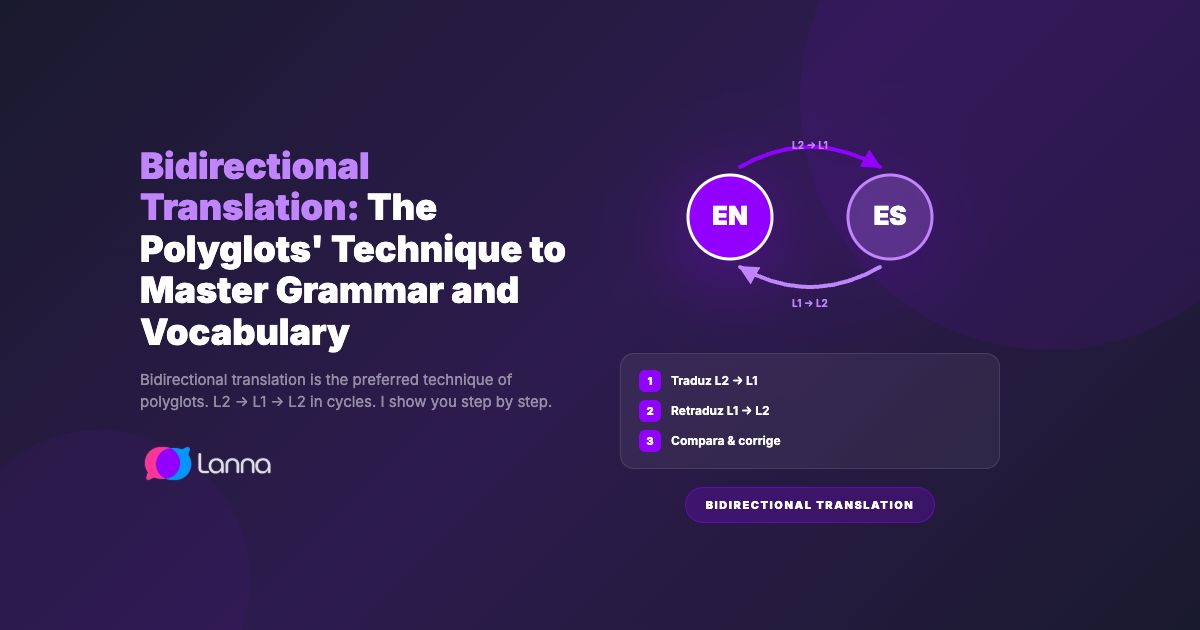
It is a technique where you translate a text from the language you are learning to your native language, and then translate your version back — comparing each step with the original. The cycle is: L2 → L1 → L2. Simple in description, powerful in execution.
The technique has existed in some form for centuries (the 19th-century grammar-translation method used something similar), but it was Luca Lampariello — an Italian who speaks over 13 languages — who popularized the modern systematic format: quality text at the right level, L2 → L1 → L2 cycle with comparison, repetition every 3-5 days, and a focus on analyzing the differences between your second translation and the original.
Why it works: the science behind it
Bidirectional translation is not just a polyglot trick — it has a solid foundation in 3 important discoveries from language learning science:
1. Output Hypothesis (Swain, 1985)
Merrill Swain, a Canadian researcher, proposed in 1985 what is now known as the Output Hypothesis. The idea: just listening and reading is not enough — producing the language (speaking, writing) forces the learner to notice gaps in their own competence. When you try to say something and get stuck, that moment of "ah, I don't know how to say that" is exactly when the brain marks the structure to learn. The second translation (L1 → L2) of the bidirectional technique is intense output — you are forced to produce each structure, and each block is a signal that the brain uses to fix it.
2. Noticing Hypothesis (Schmidt, 1990)
Richard Schmidt, an American linguist, formalized in 1990 the Noticing Hypothesis: the learner only incorporates linguistic structures that they consciously notice. Input without directed attention does not turn into learning. The comparison between your second translation and the original is literally an exercise in noticing — you are forced to notice each difference, each wrong preposition, each swapped verb tense. This is the engine that makes the method work.
3. Retrieval Practice (Karpicke & Roediger, 2008)
The most cited research on effective memory is the study by Karpicke & Roediger (2008), which showed that actively retrieving content is much more effective than passively rereading it. Asking the brain to search is what creates durable memory — not repeated exposure. The second translation of the bidirectional technique is pure retrieval: you have to search in your head for the structures instead of copying from the text.
The cycle of bidirectional translation (diagram)
5 advantages that only bidirectional translation provides
Step by step: how to do it (Lampariello method)
Step 1 — Choose material at your level
The first point is to choose material compatible with your level. If you pick a text too far above your level, you won’t be able to, you’ll get frustrated, and give up. Pick something at your level or slightly above (the principle of comprehensible input by Krashen):
- A1-A2 (beginner): 2 to 3 loose sentences. It can be from a bilingual children's book, an example from Duolingo, or a caption from a short video.
- B1 (lower intermediate): 1 short paragraph. BBC Learning English, simple song lyrics, short article.
- B2 (upper intermediate): 1 larger paragraph or 2 paragraphs. Excerpt from non-fiction, magazine article.
- C1-C2 (advanced): 1 full page. Literary essay, academic article, translated poetry.
Step 2 — First translation (L2 → L1)
Read the text in the language you are learning and translate it into Portuguese by writing. Whether by hand or typing, it doesn’t matter — the important thing is to write, not just think it. Do not consult a dictionary on the first pass, only if you get completely stuck. The idea is to force your brain to use everything it already knows before getting help.
Step 3 — Compare with the reference
After you finish, close the original and look only at your translation. Check if you captured the correct meaning. Here you can consult the reference (quality translation of the text, if available) or a dictionary for the words you didn’t know. Mark new words with a pen — they will go to your SRS later.
Step 4 — Second translation (L1 → L2)
This is where the magic happens. Take only your version in Portuguese — hide the original in L2 — and translate it back into the language you are learning. Focus on reproducing the correct grammatical structure. You will get stuck in various parts. That’s okay. Write what you know, leave gaps when you don’t know, and move on.
Step 5 — Compare with the original L2
This is where the gold lies. Open the original L2 next to your second translation and check the differences. Each difference is a fine diagnosis of your weak point. Mark each error in one of 4 categories:
- Wrong verb tense — I used present where it should have been past, etc.
- Wrong preposition — "on" vs "at" vs "in" is the classic.
- Wrong pronoun — "him" vs "his", "your" vs "yours".
- Word order — sentence structure.
After 10 texts, you will already see a clear pattern: your repeated errors. Then you know exactly what to study.
Step 6 — Repeat in 3-5 days
After 3 to 5 days, go back to the same text and redo the entire cycle. Your brain will have forgotten part, but will recognize the patterns — and this time you will mark far fewer errors. Each round is a concrete measure of progress. This is what polyglots do. Lampariello goes back to the same text 4-5 times over different weeks before considering it "mastered."
Common mistakes that nullify the benefit
- Consulting Google Translate during the first pass. Kills the noticing. The brain only learns what it is forced to search for.
- Choosing a text too far above your level. Frustrates, demotivates, and turns into mechanical copying instead of learning.
- Not comparing with the original after the second translation. Kills the feedback — and without feedback, nothing sticks.
- Doing it only once and not going back. Without repetition, the gain is only short-term (Ebbinghaus again).
- Skipping writing and only doing it mentally. Writing forces precision that mental doesn’t — you “think you know” and never test.
How long does it take to feel results
- First week: clear identification of your specific weak points. You start to notice the mistakes you always make.
- Second week: active vocabulary on the topic of the text grows quickly. 10-15 new words per cycle.
- One month: grammatical structure starts to settle. Verb tenses and prepositions stop confusing.
- Three months: transfer to other skills. Your writing in other contexts improves. Your speaking becomes faster because the structures are now automatic.
Who should use (and who should avoid)
Use if:
- You are at B1 or above and feel stuck in active production (you can read but can’t write/speak accurately)
- You want to unlock writing
- You want to improve grammatical accuracy
- You are at the intermediate plateau and don’t know how to get out
Avoid (for now) if:
- You are an absolute A0-A1 — you still don’t have a grammatical foundation to diagnose errors. Start with a structured course.
- You just want to speak quickly — for conversational fluency, shadowing is better.
- You have less than 20 minutes per day — the cycle needs continuous time to work.
Why thinking in English without translating does not conflict
There is an apparent contradiction: in another post, I advocate for stopping translating in your head. And here I’m saying to translate. How?
Answer: bidirectional translation is a deliberate exercise, done sitting down and with time. Stopping translating in your head is about the spontaneous use of the language in real conversation. These are different things — like weight training (structured exercise) vs walking (natural use of the body). Bidirectional translation is weight training for grammar; later, in real use, the brain becomes more agile because it has trained the right strength.
Frequently Asked Questions
What is bidirectional translation?
Translating from the learned language to the native and then back from the native, comparing with the original.
Who created it?
Popularized by the Italian polyglot Luca Lampariello, who speaks 13+ languages.
Do I need a teacher?
No — it’s autonomous. AI can speed up feedback, but the original method is done alone.
Does it work for beginners?
It works well from A2 onwards. A0-A1 needs structured basics first.
Difference from shadowing?
Shadowing trains oral (pronunciation, speaking). Bidirectional trains written (grammar, vocabulary). They are complementary.
How much time per day?
20-40 minutes, 4-5 times a week. Complete a cycle per session.
Start tomorrow with 3 sentences
You don’t need a large text. Take 3 sentences from what you are seeing today — a news article, a post, a book excerpt — and do the complete cycle: translate to Portuguese, close the original, translate back to English, compare. In 15 minutes you’ll complete the first cycle. In 30 days, once a day, you’ll look back and not believe how much your grammatical accuracy has improved.
Bidirectional translation with AI feedback
Lanna has a Writing module that runs the cycle L2→L1→L2 with automatic feedback — the AI compares your second translation with the original and points out exactly which grammatical structures differed. Step 5 automated.
Try Lanna for free