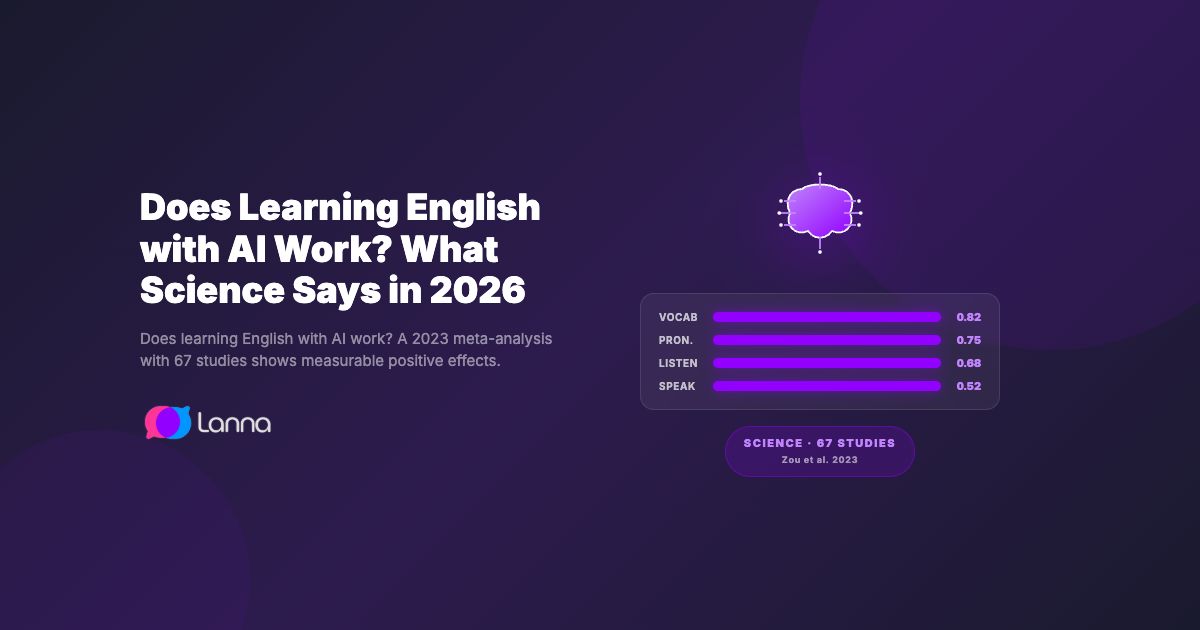

Learning English with AI works — and there's strong science validating it. The meta-analysis by Zou et al. (2023), which reviewed 67 studies published between 2015 and 2022, found a measurable positive effect compared to traditional methods. AI is especially good at vocabulary, pronunciation, and volume of speaking practice. It still doesn’t replace a human teacher in cultural context and motivation. In this post, I show what each study found, where AI shines, where it still fails, and how to use it the right way.
Look, if you're thinking, "Does learning English with AI is just another hype wave or does it really work?" that’s the right question. And there’s a validated answer — the science of language learning has been studying this seriously since 2015. This post is about what the research really shows: where AI works, where it doesn’t, and how to use it to maximize results.
I’ll cite 5 main peer-reviewed studies, show a graph comparing AI vs traditional methods, and at the end, I’ll give you a data-driven recommendation — not just an opinion.
The reference meta-analysis: Zou et al. (2023)
The most cited study in 2024 and 2025 about AI and language learning is the meta-analysis by Zou, Huang, Wang, and Xie published in Computer Assisted Language Learning. They aggregated results from 67 empirical studies published between 2015 and 2022 — covering chatbots, voice recognition, machine translation, text generation, and personalized tutoring.
The conclusion: AI has a significant positive effect on learning compared to traditional methods. But the effect size varies by skill. In passive skills (reading, vocabulary), the effect is large. In productive skills (speaking, writing), the effect is moderate — still positive, but smaller. And the gain crucially depends on the method of how AI is used, not just the fact of using AI.
Where AI shines: the skills graph
The reading of the graph is straightforward: AI works very well where feedback is objectively measurable (is the word right or wrong, is the pronunciation close or far from the standard). And it works poorly where feedback is subjective and cultural (is it polite? is it appropriate for the context? does it sound natural?).
5 areas where AI really works
1. Vocabulary and SRS (d=0.82)
The area where AI has the strongest effect. The reason is simple: AI can apply spaced repetition (SM-2 by Wozniak) automatically, generate contextualized examples on demand, and adapt difficulty to the user. The famous study by Vesselinov & Grego (2012) showed that 34 hours of Duolingo were equivalent to 1 semester of university classes in terms of vocabulary gain.
2. Pronunciation correction (d=0.75)
The Whisper by OpenAI (Radford et al., 2022) has a word-error rate below 5% in non-native English speakers — equivalent to human transcription. This allows AI to show the student, in real-time, which phonemes they are getting wrong. Specific studies on AI-based pronunciation tutors show gains of 15-25% in intelligibility after 8 weeks of use.
3. Volume of speaking practice (d=0.52)
It’s not the largest effect overall, but it’s the most transformative in day-to-day life. Belda-Medina & Calvo-Ferrer (2022) showed that conversational chatbots doubled the weekly volume of oral practice for students compared to just having lessons with a teacher. And they reduce language anxiety (Krashen's concept), which is the main enemy of introverted students.
4. Tailored comprehensible input (d=0.68 in listening)
Stephen Krashen proposed in 1985 that language is acquired when the student receives input slightly above their current level (i+1). The problem has always been that finding material at the right level is difficult. AI solves this — it generates texts and audio adapted to the student's level or simplifies existing material. Recent research (Godwin-Jones, 2022) calls this "partnering with AI" for personalized input.
5. Instant feedback (applicable to everything)
Hattie & Timperley (2007), in one of the most cited education papers in history, showed that instant feedback is one of the biggest predictors of effective learning in any domain. AI delivers this 24/7. You miss a word, get correction in 200ms, and practice again immediately. With a human teacher, this loop takes hours or days.
3 areas where AI still fails
1. Cultural context (d=0.12 — insignificant)
AI doesn’t know when something is appropriate or offensive in real social context. It doesn’t know the difference in register between "whassup" and "how do you do". It doesn’t understand specific cultural humor. This is the territory of a human teacher or real immersion.
2. Emotional motivation
AI doesn’t hug you when you’re about to give up. It doesn’t know you had a bad day. It doesn’t cheer when you progress. Students who only use AI tend to give up sooner than students with a human tutor involved — because they lack the emotional bond.
3. Fine diagnosis of causes
When a student makes a mistake, AI usually corrects the form but doesn’t identify the root cause of the error. An experienced teacher notices: "oh, you’re translating from the structure of Portuguese." AI hasn’t reached this level of meta-diagnosis on most platforms yet.
How to use AI the right way (based on evidence)
- Use AI as a volume engine. It frees the human teacher to focus on what they do best (diagnosis, motivation, culture). 5h of AI + 1h with a teacher > 6h only with a teacher.
- Prioritize the skills where AI wins. Vocabulary with SRS (d=0.82), pronunciation with feedback (d=0.75), conversation without social pressure (d=0.52). Don’t waste time trying to learn culture or creative writing only with AI.
- Combine with real input. Series, podcasts, books, news. AI does not replace exposure to the language "in real life".
- Do not ignore explicit grammar at the beginning. If you are a beginner (A0-A1), take a quick structured course before relying solely on AI. After A2, AI accelerates.
- Measure your real hours. The FSI table still applies: 600-750 hours for B2/C1. AI cuts the time per hour, but does not erase the hours.
The data-driven recommendation
Learning English with AI works — especially for Brazilian adults who work, don’t have time for in-person classes, and need measurable results. Studies clearly support the use of AI as a primary tool, provided it is combined with: (1) the correct method based on comprehensible input, (2) daily active production, (3) SRS for vocabulary, (4) consumption of real content in English.
Those who rely only on AI and ignore real content or active production won’t go far. Those who use AI as a volume engine and combine it with scientifically validated principles learn faster and at a lower cost than ever before. That’s the thesis behind Lanna.
Frequently Asked Questions
Will AI replace English teachers?
Not completely, but it changes the role. The teacher becomes more of a coach, less of a content transmitter.
What is the strongest study on AI and languages?
The meta-analysis by Zou et al. (2023), which aggregated 67 studies.
Does AI work for children too?
It works, but children learn better through natural immersion. For children, AI is a complement; for adults, it can be the base.
How long will it take to see results?
In 4-6 weeks with consistent use (30 min/day), measurable gains are already possible.
What is the biggest risk?
Passive dependence — using AI as a crutch and never testing in real situations with humans.
Start today with method
If you’re convinced that AI is worth it (science agrees), the next question is how to use. The research-based recommendation: 30 minutes a day combining voice conversation (d=0.52), vocabulary SRS (d=0.82), pronunciation with feedback (d=0.75), and tailored comprehensible input (d=0.68). In 6 weeks, you’ll feel the difference.
Research-based AI, not hype
Lanna combines everything the meta-analysis identified as effective: SRS + pronunciation tutor + speaking with AI + tailored comprehensible input. All in one flow.
Try Lanna for free