
Is pronunciation and accent the same thing?
First of all, it is essential to understand a difference that many people confuse: pronunciation is not accent. Pronunciation is the ability to produce the sounds of a language in a way that you can be understood. Accent is the "color" of your speech — the influence of your native language on how you speak.
Everyone has an accent, including native speakers. A Texan sounds different from a New Yorker. A Portuguese from Lisbon sounds different from a Brazilian from São Paulo. The realistic goal is not to eliminate your accent — it is to have a clear enough pronunciation to be understood effortlessly.
When you accept this, the pressure decreases enormously. You don’t need to sound like a native — you need to sound understandable. And that is much more achievable than it seems.
How to naturally associate sounds with words?
The first technique is surprisingly simple: read and listen at the same time. When you follow a text while listening to the corresponding audio, your brain creates direct connections between how the word is written and how it sounds.
This is especially important in languages where writing and pronunciation are very different — like English and French. By seeing "through" and hearing /θruː/ simultaneously, you internalize the actual pronunciation without needing to memorize phonetic rules.
Do this with content suitable for your level, where you understand most of the text. Podcasts with transcripts, videos with subtitles in the original language, and audiobooks with the text in hand are ideal for this practice.
What speaking techniques improve pronunciation?
Listening is essential, but pronunciation only truly improves when you put your voice out there. Three techniques stand out:
Shadowing
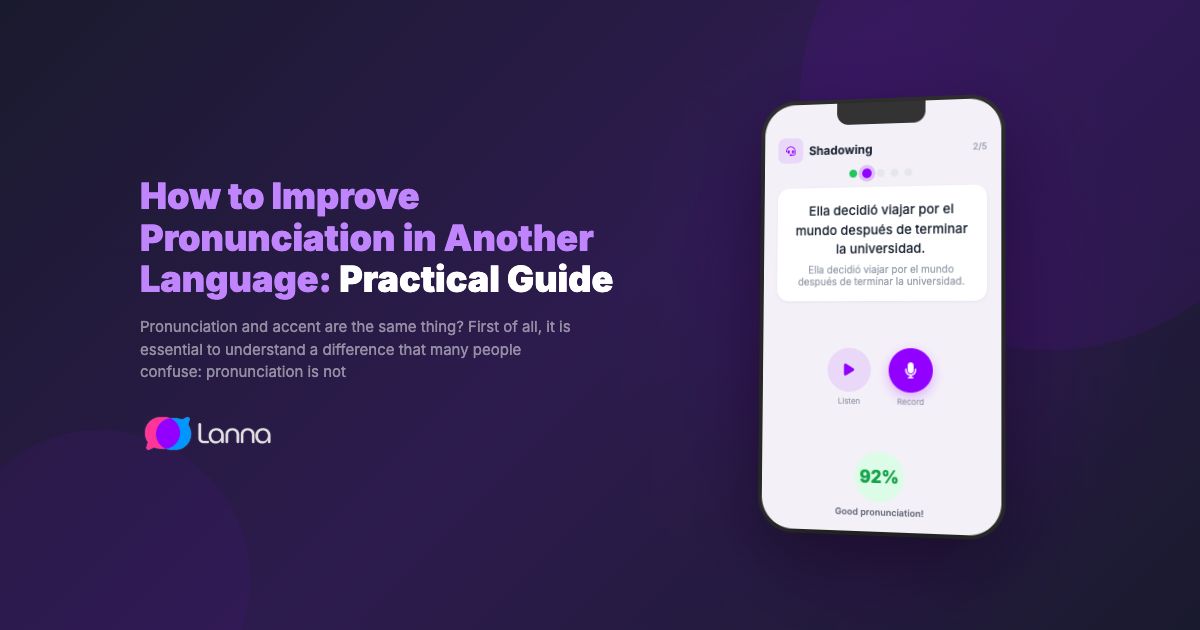
Shadowing is one of the most powerful techniques for pronunciation. You listen to a sentence and immediately repeat it, imitating not only the words but also the intonation, rhythm, and pauses of the native speaker. It’s like "shadowing" someone’s speech — hence the name.
Shadowing trains your mouth and your ear at the same time. Your facial muscles learn to produce new sounds, and your ear learns to distinguish nuances that were previously unnoticed.
Talking to yourself
It may sound strange, but talking to yourself in the language is one of the best ways to practice pronunciation without pressure. Describe your day, narrate what you are doing, answer imaginary questions. The advantage is that you can experiment with difficult sounds without fear of judgment.
Talking with natives
Nothing replaces real practice. Talking with native speakers exposes you to authentic pronunciations and forces you to produce sounds in real-time. If you still don’t feel ready for long conversations, start with short interactions — asking for information, greeting, making simple questions.
Why is recording your own voice essential?
This is the technique that most people avoid — and the one that makes the most difference. Recording your voice and listening back reveals mistakes that you don’t notice while speaking.
When we speak, we are focused on the content — on what we want to say. There’s no attention left for how we are saying it. But when we listen to the recording, the focus shifts to the form, and pronunciation errors jump out at you.
The process is simple:
- Choose a short excerpt from an audio with a native speaker
- Record yourself speaking the same excerpt
- Compare the two recordings — pay attention to specific sounds, rhythm, and intonation
- Identify the differences and practice the sounds that diverge the most
- Repeat the cycle until the difference decreases
At first, listening to your own voice can be uncomfortable. But that discomfort passes quickly, and the results are immensely rewarding.
How does reading aloud improve pronunciation?
Reading aloud is one of the most underrated ways to practice pronunciation. When you read silently, your mouth doesn’t practice the sounds — and pronunciation is, at its core, a physical skill. Your facial muscles, tongue, and vocal cords need training to produce sounds that don’t exist in Portuguese.
Set aside 10-15 minutes a day to read a text aloud. It can be an article, a book excerpt, or even the subtitles of a video. The important thing is to let your voice out — don’t mumble, don’t whisper. Speak with volume and clarity, as if you were presenting to someone.
Intensive reading pairs well with this practice: choose a short text, read it aloud several times, and notice how fluency and pronunciation improve with each repetition.
Does asking for feedback make a difference?
Yes, it does a lot. Our ear is biased — we tend to hear what we want to hear in our own speech. An external ear, especially from a native speaker or experienced teacher, identifies problems that go completely unnoticed by us.
If you don’t have access to a teacher, there are alternatives:
- Online communities: send recordings in language forums and ask for feedback
- Language partners: find someone learning Portuguese who speaks the language you are studying — you correct each other
- AI tools: apps that compare your pronunciation with that of natives and give objective scores
Feedback transforms pronunciation practice from a blind exercise into a targeted process, where you know exactly what you need to improve.
Summary: how to improve pronunciation in 6 steps
- Read and listen at the same time to associate sounds with words
- Practice speaking techniques: shadowing, talking to yourself, conversing with natives
- Record your voice and compare it with the original audio
- Read aloud daily — let your voice out, don’t mumble
- Ask for feedback from others or use assessment tools
- Repeat the cycle — repetition is what transforms practice into skill
Remember: the goal is not to sound like a native. It is to be easily understood. Relax, enjoy the process, and trust that improvement comes with consistent practice.
Want to practice pronunciation with automatic feedback? At Lanna, you record your voice sentence by sentence, and the artificial intelligence compares it with the native audio, giving a score from 0 to 100. You can also practice shadowing, reading aloud, and conversation with AI — all in one place. Start for free and see your pronunciation evolve.