
What is the learning curve?
If you've ever felt that at the beginning you learned everything very quickly, but then got stuck and stopped progressing — know that this has a name: learning curve. And it happens to everyone.
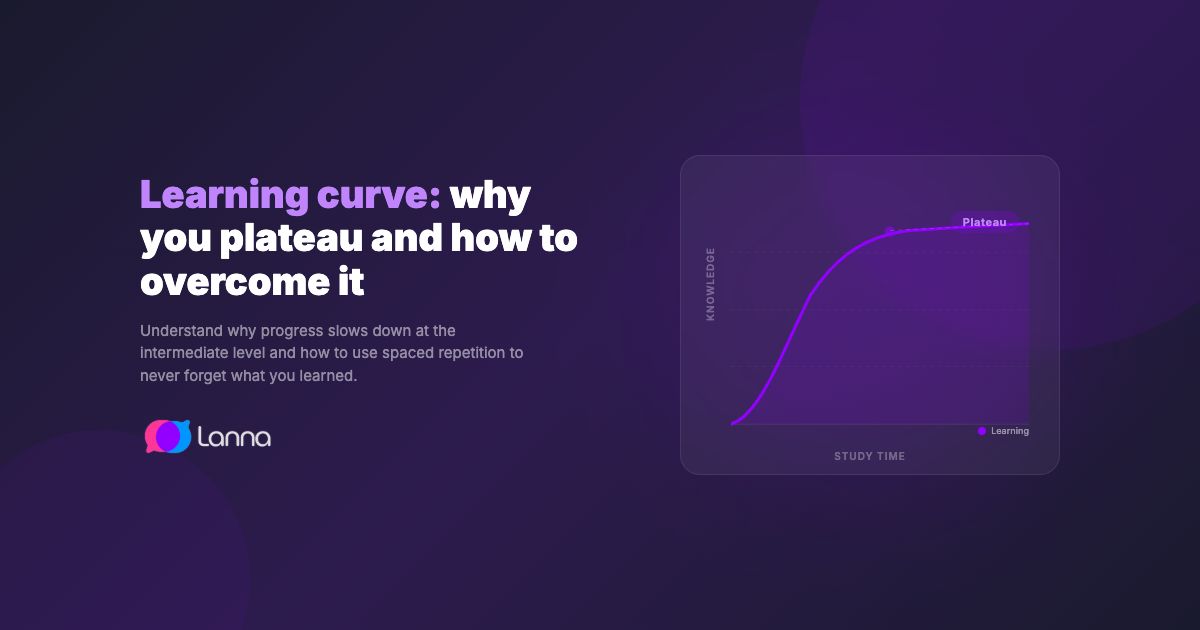
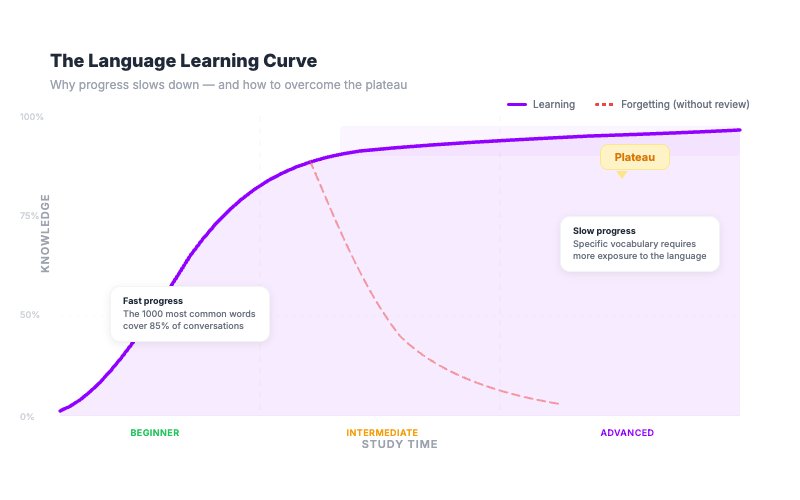
The learning curve shows that at the start of any learning process — whether it's a language, an instrument, or a sport — the evolution is rapid. You absorb a lot in a short amount of time. But after a while, you hit the plateau: that feeling that you've stopped evolving, even though you keep studying.
Why do we learn so fast at the beginning?
When you start learning a language, the most common words repeat all the time. "I", "the", "is", "have", "go" — these words come up in practically every text and conversation. Since you are constantly exposed to them, your brain absorbs them quickly.
That's why in the first few weeks you feel like you exploded: you learned how to introduce yourself, order things at a restaurant, understand simple sentences. The evolution is visible and motivating.
Why do we get stuck at the intermediate level?
As you progress, new words become less frequent and more specific. Medical vocabulary, politics, philosophy, idiomatic expressions — all of this appears much less frequently than basic words.
The result? You need a lot more exposure time to encounter these new words. Progress continues, but it becomes less noticeable. It's the famous intermediate plateau.
The forgetting curve: why you forget what you studied
There is a second curve that works against you: the forgetting curve, discovered by Hermann Ebbinghaus. He showed that:
- In 20 minutes, you've already forgotten 60% of what you learned
- In 1 day, you've forgotten 80%
- In 1 week, almost everything is gone
You know when you study for a test, think you've learned everything, and the next day you remember nothing? That's exactly it. The brain uses 20% of the body's energy — if it stored absolutely everything we see, hear, and feel throughout the day, it would be unsustainable. So it discards what doesn't seem important.
How to overcome the two curves: spaced repetition
The solution for both curves is the same: spaced repetition.
Instead of studying something once and only reviewing it weeks later, you review at increasing intervals: after 1 day, after 3 days, after 7, after 15 — and so on. With each review, the brain understands that the information is important and moves it to long-term memory.
The results are powerful:
- You retain much more — instead of forgetting 80% in a day, you keep 90%+
- Each review requires less effort — the information is almost fixed
- The plateau is shorter — because you’re not relearning what you forgot
How the brain really learns: neural connections
All information in the brain is stored through connections between neurons — the synapses. When you learn a new word, a weak connection is created. That's why at first you have to think a lot before speaking — your brain is slowly searching for the information.
The more you practice and repeat, the more strong and fast this connection becomes. Until it reaches a point where the word comes out naturally, effortlessly — just like in your mother tongue. That is fluency.
Intentional study vs. unintentional study
To accelerate these connections, you need both types of study:
- Intentional study: sitting down, focused, with notebook and pen. Intensive reading, exercises, notes. This is where you learn new things.
- Unintentional study: listening to podcasts, watching videos, reading for pleasure, doing shadowing in the car. This is where you strengthen what you already know — without even realizing you’re studying.
Both are essential. Only the intentional one can be tiring and demotivating. Only the unintentional one is too slow. The combination of both is what truly accelerates learning.
How long does it take to learn a language?
The U.S. State Department classifies languages into 5 categories of difficulty for speakers of closely related languages:
- ~600 hours: Spanish, Italian, French, Portuguese
- ~750 hours: German
- ~900 hours: Indonesian, Malay
- ~1,100 hours: Russian, Hungarian, Turkish
- ~2,200 hours: Japanese, Chinese, Arabic, Korean
If you study 1 hour a day in a traditional school (40 hours/year), it would take 15 years to learn English. But if you combine intentional + unintentional study and spend 2 hours a day exposed to the language, it reduces to less than 1 year.
The more time you spend with the language, the faster you learn. It's that simple.
Summary: how to use the learning curve to your advantage
- Accept the plateau: it’s normal and temporary. Don’t give up when you feel like you’ve stopped progressing.
- Use spaced repetition: review at increasing intervals to overcome the forgetting curve.
- Combine the two types of study: intentional (focused) + unintentional (immersion).
- Spend more time with the language: the more exposure, the faster the neural connections strengthen.
- Gradually challenge yourself: move from easy content to material slightly above your level.
Want to accelerate your learning curve? At Lanna, every material you study generates automatic spaced reviews — the app schedules the exact moment to review so you never forget what you learned. Combined with flashcards, pronunciation, and exercises, it’s the most efficient way to overcome the plateau.