
What is bidirectional translation?
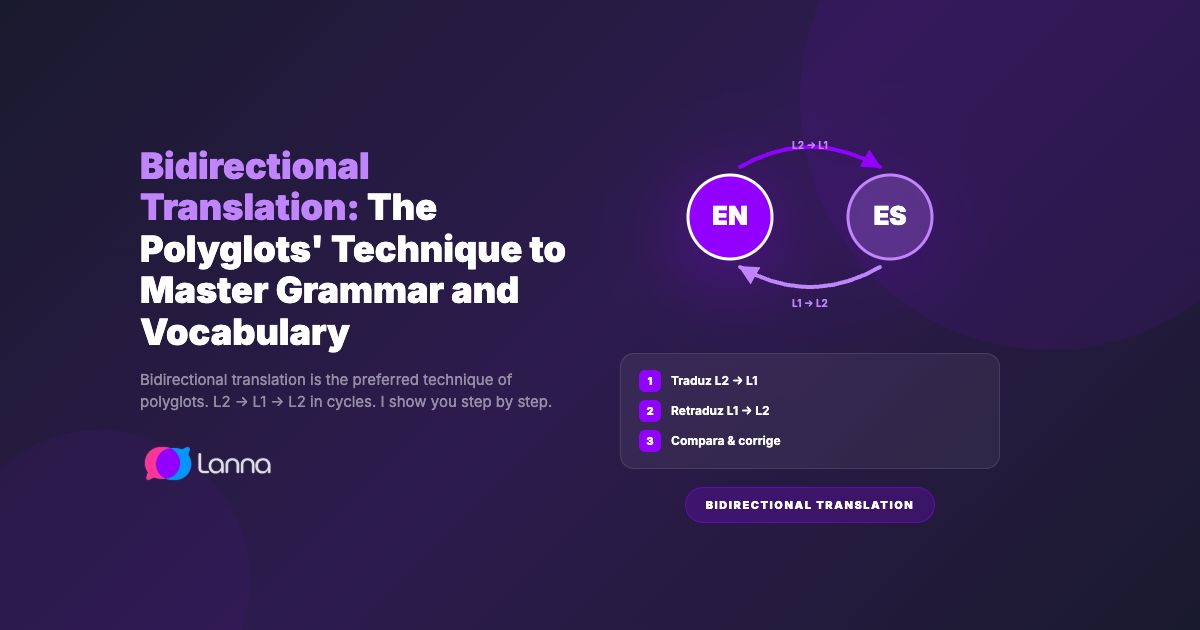
Bidirectional translation is a study technique popularized by the Italian polyglot Luca Lampariello, who speaks more than 10 languages fluently. The concept is simple but extremely powerful: you translate a text from the language you are learning into your native language, and then translate it back to the original language.
In other words: if you are learning English, take a text in English, translate it into Portuguese, and then, some time later, translate that Portuguese back into English. Then compare your version with the original text and analyze the differences.
Sounds simple? It is. But what this technique reveals about your level of mastery of the language is surprising — and that’s exactly why polyglots consider it one of the most effective methods for active learning.
How does bidirectional translation work in practice?
The process has four clear steps:
- Choose a text in the language you are learning. It can be a paragraph from a book, a snippet from an article, a video caption, or even sentences from a lesson. The important thing is that it is at your level.
- Translate it into Portuguese. Write the translation by hand or typed. Try to capture the meaning, not translate word for word.
- Wait for a while. It can be a few hours or even until the next day. The break is important so that you forget the exact words of the original text.
- Translate the Portuguese back into the foreign language, without consulting the original. Then, compare your version with the original text and analyze each difference.
The magic is in the final comparison. Each difference between your version and the original reveals with surgical precision what you still do not master: missing vocabulary, grammatical structures you haven’t internalized, idiomatic expressions you are unaware of.
Why is this technique so effective for writing?
Bidirectional translation is probably the most active way to study a language. Unlike reading or listening (which are receptive skills), translating back requires you to produce the language — and producing is much more demanding than understanding.
When you read a sentence in English and understand the meaning, you may have the illusion that you "know" that structure. But when you need to reconstruct it from scratch, you discover whether you really know it or just recognize it. It’s the difference between recognizing someone’s face and remembering the person’s name.
The benefits for writing are numerous:
- Identifies your real level of expression: shows exactly what you can and cannot produce
- Reveals grammatical gaps: structures you understand when reading but cannot use when writing
- Expands active vocabulary: transforms words you only recognize into words you can use
- Teaches natural expressions: by comparing with the original, you learn how natives actually express themselves
- Trains different registers: you notice nuances of formality, slang, and idiomatic expressions
What is the right level of text to use?
The choice of material is crucial. Texts that are too difficult will frustrate you; those that are too easy won’t challenge you. The golden rule is: choose something that you understand well when reading, but that would be challenging to rewrite.
For each level, a different amount works best:
- Beginner: start with 1 to 3 short sentences. It can be a mini-dialogue or everyday phrases.
- Intermediate: work with paragraphs of 5 to 10 sentences. Simplified news articles are ideal.
- Advanced: use longer texts — excerpts from books, opinion articles, even song lyrics.
Choosing content appropriate to your level is one of the most important decisions for the technique to work. If the text is above your level, the final comparison will reveal so many differences that you won’t know where to start.
How often should I practice bidirectional translation?
Bidirectional translation is a technique of high cognitive intensity — it requires total concentration and expends more mental energy than listening to a podcast or watching a video. Therefore, it doesn’t need to (and shouldn’t) be done all the time.
A balanced study routine can include bidirectional translation 2 to 3 times a week, combined with other practices:
- Input days: reading, listening, content consumption
- Output days: bidirectional translation, free writing, speaking practice
- Review: flashcards with spaced repetition to reinforce new vocabulary
The most important thing is to repeat the cycle with the same text. Translating a text once already brings benefits, but translating it two or three times (with gaps of days) is where the technique really shines. With each repetition, the differences decrease — and this visible progress is extremely motivating.
Bidirectional translation vs. simple translation: what’s the difference?
Translating from the foreign language to Portuguese (simple translation) trains your comprehension. It is a receptive exercise — you process the meaning, but don’t need to produce the language.
Translating from Portuguese back to the foreign language (the second step of bidirectional) trains your production. You need to remember vocabulary, apply grammar, choose between synonyms — all active skills.
The combination of both directions is what makes the technique complete: you train comprehension AND production in the same exercise, and the final comparison closes the cycle with an accurate diagnosis of your level.
Common mistakes when practicing bidirectional translation
- Translating word for word: the goal is to capture the meaning and re-express it, not to copy structures. Languages have different ways of saying the same thing.
- Not waiting between translations: if you translate back immediately, you will remember the exact words of the original. The break is essential.
- Text too difficult: if you don’t understand 80%+ of the original text, it is above your level for this technique.
- Not analyzing the differences: the final comparison is the most important part. Each difference is a learning opportunity — don’t skip it.
- Doing it only once: repeating the cycle with the same text is where real consolidation happens.
Summary: bidirectional translation in 5 steps
- Choose a text in the foreign language, appropriate to your level
- Translate it into Portuguese, focusing on the meaning
- Wait a few hours or until the next day
- Translate back into the foreign language, without consulting the original
- Compare with the original and analyze each difference — these are your gaps
Bidirectional translation is the technique that transforms passive knowledge into active skill. It is labor-intensive, requires concentration, and has no shortcuts — but the results in writing, grammar, and vocabulary are unparalleled.
Want to practice writing with intelligent feedback? At Lanna, the Writing mode works like a guided bidirectional translation: you translate sentences from Portuguese to the language you are learning, and the artificial intelligence analyzes your response, pointing out errors and suggesting improvements. Combine it with spaced repetition flashcards to reinforce new vocabulary. Start for free.