
How does our brain learn a new language?
Before diving into any study method, understanding how we learn is the first step to making the process more effective and enjoyable. Let’s uncover the science behind language learning.
Is method more important than talent?
Let’s dispel a myth: you don’t need to have a "gift" to learn languages. We usually only see the final result — polyglots, great artists, elite athletes — and think it was all natural talent, ignoring the entire process they went through.
Mozart, for example, was considered a prodigy. But his father was a great pianist and made him practice from the age of 4. In 1993, a study from the University of Colorado introduced the concept of 10,000 hours of deliberate practice — the time needed to reach an extreme level in any activity.
The researchers' conclusion is clear: what distinguishes an expert from the majority is the commitment to deliberate practice over time. Method surpasses talent.
How does memory work in language learning?
Our brain consumes 20% of all the body’s energy — double that of the heart. Imagine if all the information we are exposed to were stored? It would be chaos.
That’s why, if the brain doesn’t review a stimulus, it discards it. Information is stored and retrieved through connections between neurons — the synapses. When we are learning something new, these connections are slower. And when they are not reinforced, they weaken — that’s why we forget.
To make these connections lasting, we need to stimulate them repeatedly, whether intentionally (active study) or unintentionally (reading a book for pleasure, watching a movie).
What is the Forgetting Curve and how to combat it?
In 1885, Hermann Ebbinghaus described the Forgetting Curve: the speed at which we lose information. In his tests with meaningless words, he discovered that we forget 80% of the information within the first day.
The solution? Spaced repetitions. Review the content after 1 day, then 3 days, then 7, and so on. Each review strengthens the neural connections, making memory faster and more effective.
Over time, these connections become automatic — like driving a car. At first, coordinating the accelerator, brake, and clutch seems impossible. Later, we do everything without thinking.
What is the role of emotions in language learning?
Take a quick test: Who was your first kiss? What did you have for lunch last Tuesday?
Probably you remember the first and have no idea about the second. Emotions are fundamental in the formation of memories. That’s why the learning process must have genuine motivation — whether professional, cultural, personal, or simply out of passion.
And the study material makes all the difference: don’t read a book just because it’s in the language you want to learn. Read because the subject interests you. Want to learn to meditate? Study in French. Love music? Learn with the lyrics you enjoy.
What are the best tips for learning languages effectively?
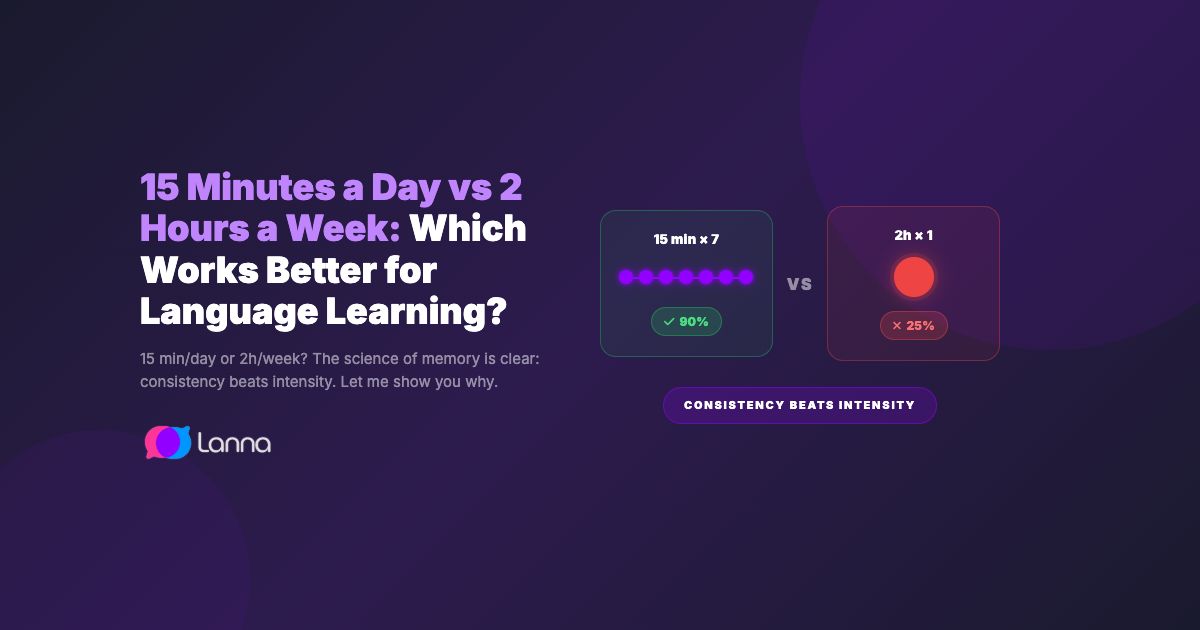
- Create a consistent routine: it’s better to practice 15 minutes every day than 2 hours once a week. Consistency is more important than intensity.
- Stay focused during study: remove distractions like your phone and TV. Conscious practice makes a huge difference in content absorption.
- Relax: stress produces cortisol, which hinders the formation of new memories. Accept that it’s a gradual process and trust it.
- Consume a lot of content you enjoy: the input of content is how children learn their mother tongue — they are bombarded with information until they start reproducing it.
- Use dead time: on the bus, in the car, at the gym, cleaning the house — all these moments can be used to listen to podcasts or music in the language.
- Repeat: repetition is the key piece to move from "I know this word" to "I master this word". We will only be able to express ourselves when we have real mastery.
How to apply this science in practice?
Lanna was created exactly based on these principles: learning through real and interesting content, with spaced repetition in flashcards, pronunciation and writing exercises with AI, and an experience that makes studying enjoyable.
Transform any video, text, or audio into a complete interactive lesson — with 8 different learning modes.
Start learning with Lanna — science in favor of your language learning.