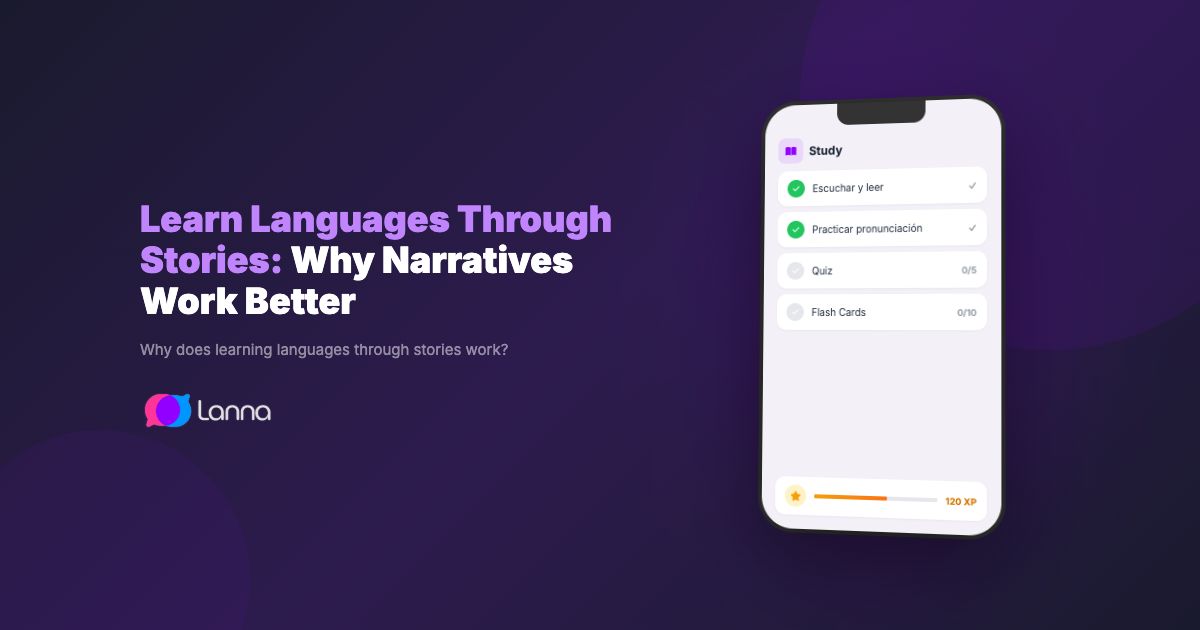

Why Learning Languages Through Stories Works?
If you struggled to learn English through traditional methods throughout high school, know that there is a much more effective way: the natural learning method, based on consuming real and authentic content in the language you want to learn.
When we talk about "stories," think of any content you would consume in your own language: YouTube videos, podcasts, books, series. The difference is that now they are in the language you are learning.
How Do Stories Help You Spend More Time with the Language?
One of the most important points in language learning is the time we spend exposed to it. This involves how much we dedicate daily to listening, speaking, reading, and writing.
A study from the Foreign Service Institute's School of Language Studies shows that learning time is directly related to daily exposure to the language. When you consume interesting stories—whether watching a travel vlog or listening to a podcast—exposure time increases naturally, without effort.
Why Do We Learn More Words Through Context?
Our brain works better when it creates connections between one thing and another. Creating loose vocabulary lists and reviewing them without context is an unnecessary effort.
Through a story with a defined theme, related words appear naturally and strengthen memory. It’s like a chain of associations:
- Coal → Climate change → Concerns → Drought → Shortages...
- Watermelon → Red → Tomato → Salad → Health...
This way, without any deliberate effort, you learn more words with a much better memorization capacity because there are real connections between them.
What Characteristics Should Ideal Content Have?
In the natural method, content is the starting point. It should be:
- Comprehensible: you should understand at least 70% to 80% of what you are reading or listening to. If you don’t grasp the main message, the content is above your level. As the concept of Comprehensible Input states: we only learn what we understand.
- Interesting: the learning process should not be boring. If you love music, seek out content about music. Imagine learning to play piano by watching videos in Italian, or editing videos while watching tutorials in English.
- In the right format: choose content that allows you to read and listen at the same time—videos with subtitles or podcasts with transcripts. This is crucial for absorbing both reading and pronunciation.
Do Stories Also Help Language Teachers?
If you are a language teacher, story-based lessons can replace repetitive grammar exercises. Student motivation is higher, and through stories in the classroom, students:
- Learn more vocabulary
- Improve listening comprehension and speaking
- Show better results compared to students focused only on grammar
The Story Listening method, developed by researchers in the field, demonstrates how storytelling in the classroom completely transforms the learning experience.
How to Use Stories in Your Daily Life?
The golden rule is simple: never watch or read something just because it’s in the language you want to learn. Consume it because you are genuinely interested in the content.
- If you like surfing, consume stories about surfing.
- If you like makeup, there are hundreds of channels in any language on the topic.
- If you love cooking, technology, sports—there is content for everything.
With Lanna, you can turn any YouTube video or text into a complete interactive lesson—with synchronized audio, word translations, pronunciation exercises, writing, and much more. It’s the easiest way to learn languages through stories that you actually enjoy.
Try Lanna for free and start learning with the content you love.