
What is Reading for Pleasure and How Does it Help in Learning Languages?
It is clear to everyone that reading is fundamental in language development. Through it, we learn new words, strengthen those we already know, and absorb the grammatical structure of the language naturally.
However, when we talk about reading, there are two distinct ways to practice it:
- Intensive Reading: is the active study of material, with translation, notes, and detailed analysis.
- Extensive Reading: is reading for pleasure, without effort, simply enjoying the content.
In this article, we will talk about Extensive Reading — the act of reading for long periods without worrying about translating every unknown word. The only exception is words that compromise the overall understanding of the text.
Unlike Intensive Reading, Extensive Reading is a completely relaxed and enjoyable practice. It’s about lounging on the couch with that book you love, a magazine, or even comics. Learning a new language is, above all, about being exposed to it as much as possible.
What are the Benefits of Extensive Reading for Learning Languages?
- Increases Vocabulary: studies show that we need between 20 to 50 contacts with a word to truly learn it. Extensive Reading provides this natural repetition, effortlessly.
- Improves Writing: the more contact you have with the language, the more mastery you acquire, making it easier to reproduce it through writing.
- Reinforces What You Already Know: repetition is crucial to keep knowledge active. With extensive reading, you reinforce words and phrases you have previously learned.
- Creates the Habit of Reading: as you don’t need to worry about understanding everything, reading becomes light and generates extra motivation to continue.
What Content to Choose for Reading for Pleasure?
Always remember: we only learn what we understand. The level of the content should be very close to your current level, so there is no effort involved. The ideal material should be:
- Interesting: choose something that genuinely sparks your curiosity. If you don’t like romance, don’t read a romance just because it’s in the language you want to learn.
- At Your Level: you should understand the main message of the text and at least 90% of the words. If it’s too difficult, stop and choose another material.
Examples of ideal content to read for pleasure:
- Magazines on topics you like
- Comics and graphic novels
- Newspapers and blogs
- Short books, no more than 100 pages
When and How to Practice Extensive Reading?
The main goal is to read for pleasure, without effort. The best moments are those when you feel most comfortable:
- Before Bed: reading in bed is a perfect moment. You will have contact with the language in the minutes before sleeping, aiding in memory consolidation.
- On the Couch: relaxed, sitting or even with your legs up.
- While Traveling: by the pool, at leisure, enjoying the reading.
- During Downtime: on your way to work, during lunch — any moment that allows for 20 to 30 minutes of quiet reading.
How Can Technology Help with Extensive Reading?
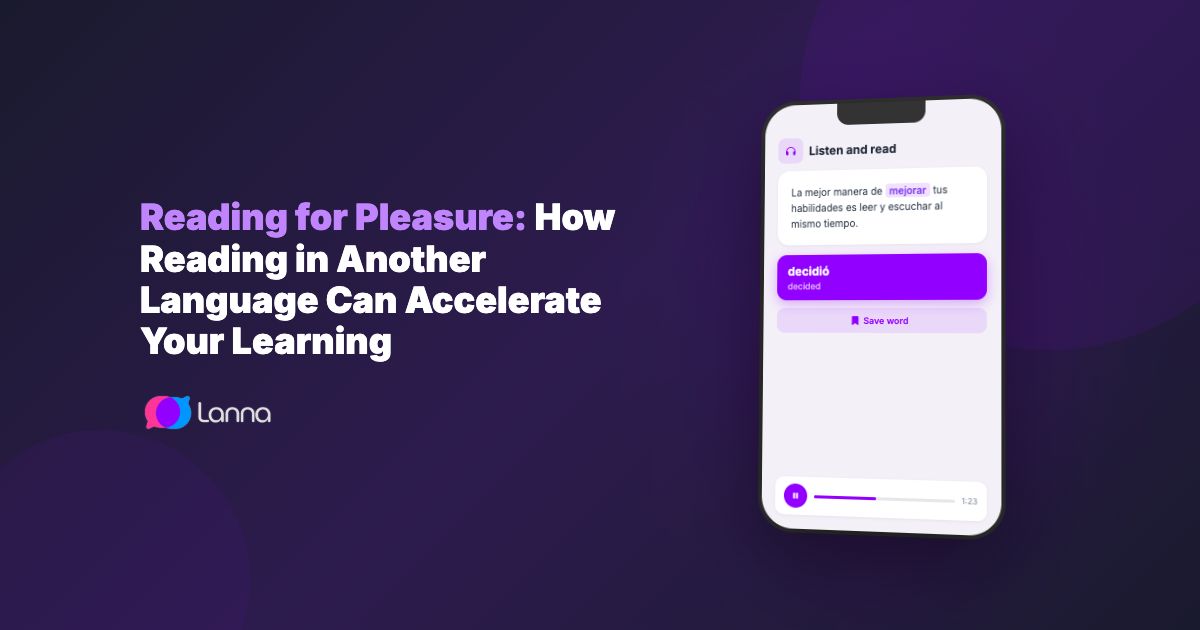
Today, tools like Lanna transform any content into interactive study material. You can import texts, YouTube videos, or audio and use the Audio and Text function to read and listen simultaneously — combining extensive reading with listening practice.
If you find a word you want to remember, just touch it to see the translation and save it in your personal dictionary. Then, the flash cards with spaced repetition system ensures that you memorize it effortlessly.
Reading for pleasure is one of the most powerful yet underestimated strategies in language learning. Start today: choose something you love to read, at the right level, and enjoy the process.
Start learning with Lanna — turn any content into an interactive lesson and learn at your own pace.