
Spaced repetition (SRS) is the technique that shows the same word at increasing intervals (1 day, 3 days, 7, 15, 30) to fix it in long-term memory. The SM-2 algorithm, created by Piotr Wozniak in 1985, is the basis of nearly all modern flash card apps. Here I explain how it works, why it beats traditional rote memorization, and how to apply it to language vocabulary.
Look, if there’s one technique that has forever changed how we memorize vocabulary, it’s spaced repetition. In English, it's called Spaced Repetition System (SRS). It’s the opposite of what school taught you — instead of memorizing a list of words all at once, you review small portions at increasing intervals, right before you forget.
The result is astonishing: with just 5 minutes a day, you can solidify hundreds of words a month in long-term memory. Without SRS, you would memorize the same words 10 times just to forget 8. This post explains how it works, who invented it, and how to apply it — including in language apps like Lanna (a Brazilian AI language learning platform).
What is spaced repetition
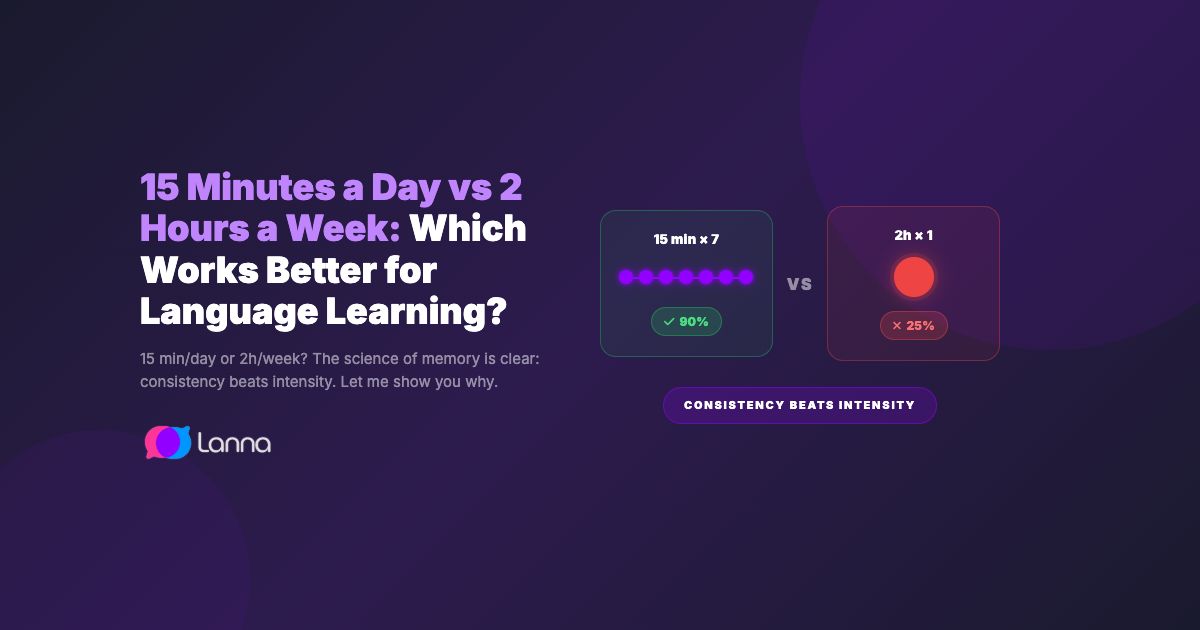
Spaced repetition is a memorization technique based on the psychological effect called the spacing effect. Research in psychology shows that we remember more when reviews are distributed over time, not concentrated. Studying 10 minutes a day over a week yields much more than 70 minutes straight in a single day.
The trick of SRS is not to review words you already know (wasting time) nor to let words you are forgetting slip through (losing learning). An algorithm calculates the exact moment to bring each word back — usually well before you forget it but well after you have “recorded” it.
Who is Piotr Wozniak and the story of SM-2
Piotr Wozniak is a Polish researcher obsessed with human memory. In 1985, still a medical student, he wanted to memorize the absurd amount of medical terms without losing his life. He began recording how long he remembered each word before forgetting and discovered patterns.
From these patterns came the SM-2 algorithm — a simple formula that adjusts the review interval based on how easy the student reported it to be. Wozniak then founded SuperMemo, pioneering SRS software, and since then has created more advanced versions, but SM-2 remains the most used because it is simple, transparent, and effective.
How SM-2 works in practice
When you review a card, you choose from 4 options:
- Again (I got it wrong): the interval goes back to 1 day, difficulty increases.
- Hard (I got it right but with effort): the interval increases slightly.
- Good (I got it right normally): the interval doubles (more or less).
- Easy (I got it right very easily): the interval increases significantly.
Practical result: a word you marked Good will show up in 1 day, then 3 days, then 7, then 15, then 30, then 75... and in 6 months it’s solidified. If you mark Hard, it takes longer. If you get it wrong, you start over from 1 day.
Why SRS works for language vocabulary
Language vocabulary is the PERFECT use case for SRS. You need to memorize hundreds (thousands) of words, each with pronunciation, spelling, meaning, and examples. Without a method, you forget everything. With traditional rote memorization, you lose 80% in 48 hours (Ebbinghaus's forgetting curve). With SRS, you solidify it forever.
That’s why practically every serious language app uses SRS in some form. Anki, Memrise, Quizlet, and Lanna — all run some variant of SM-2.
Ebbinghaus's forgetting curve
To understand why SRS is so necessary, you need to understand the forgetting curve. Hermann Ebbinghaus, a 19th-century German psychologist, was the first to scientifically measure how much we forget. The results were shocking for the time:
- In 20 minutes: you forgot 60% of what you learned.
- In 1 hour: 56%.
- In 1 day: 80%.
- In 1 month: 90%.
That’s why studying for a test the night before is so inefficient — you forget almost everything right when you need it. SRS solves this problem by reinforcing memory WITHIN the window where you still remember.
Common mistakes when using SRS
- Adding too many cards at once. 100 new cards on the first day = 100 reviews tomorrow + 100 new cards = 200 reviews. It becomes unsustainable in 1 week. Limit to 10-20 new cards per day.
- Marking everything as Easy. This will absurdly increase the intervals and you will forget. Be honest.
- Skipping days. SRS relies on you reviewing EVERY day. Skipping 3 days accumulates 100 review cards and you give up.
- Cards only with loose words. "House = casa" doesn’t work well. Better: a sentence with the word. Context solidifies much more.
- Not syncing audio. A card with only text loses the sound. A card with native audio also trains pronunciation.
How Lanna applies SRS
When you study content in Lanna and tap on an unknown word to see the translation, it automatically goes to your flash card deck. The next day (and then 3, 7, 15, 30...), the algorithm shows the word back to you. Each card comes with native audio, example sentence, and translation.
To understand the whole method, take a look at the post about Comprehensible Input. The two theories complement each other: comprehensible input introduces vocabulary in context, SRS solidifies vocabulary in the long term.
Frequently asked questions
What is SRS?
Spaced Repetition System — a technique that shows information at increasing intervals to solidify it in long-term memory.
What is SM-2?
Algorithm created by Piotr Wozniak in 1985 that calculates the ideal interval between reviews. The basis of Anki and Lanna.
Who is Wozniak?
Polish memory researcher, founder of SuperMemo, creator of SM-2.
How long to solidify a word?
5-8 reviews in 1-3 months, with just a few minutes a day.
Anki or Lanna?
Anki is flexible but requires you to set everything up. Lanna is integrated — a word you save automatically becomes a card.
How many cards per day?
10-20 new + 30-60 reviews. Sustainable.
Ready to apply?
If you’ve never used SRS, this is the concept that will most change your way of learning. Start small: 10 new words a day, 5 minutes of review. In 1 month you’ll solidify 200-300 words. In 6 months, 1500. It’s the most efficient way to build an active vocabulary that exists.