
Why is vocabulary more important than grammar?
There is a phrase from the Italian polyglot Luca Lampariello that summarizes it well: "Words are the bricks of a wall." Each new word you learn strengthens your ability to communicate. Each additional brick makes the wall sturdier.
Most traditional courses focus on grammar and ignore vocabulary. The result? Students who can conjugate verbs perfectly but freeze when it’s time to speak because they don’t know enough words. If you master grammar but have a limited vocabulary, you won’t be able to express yourself. If you know many words but make grammatical mistakes, you will still be understood.
This is why expanding vocabulary is one of the most important — and most neglected — activities in language learning.
How many times do I need to see a word to learn it?
Research shows that you need to encounter a word 15 to 20 times before you really learn it and can use it actively. It’s not enough to see it once in the dictionary and write it down — you need to find it in different contexts: in a text, in a song, in a conversation, in a video.
The process of learning a word follows stages:
- First contact: you see the word but forget it on the same day
- Vague recognition: "I’ve seen this word somewhere before"
- Passive comprehension: you understand when you read or hear it, but can’t use it
- Active mastery: you use it naturally in speech and writing
To speed up this journey, you need three things: context, techniques, and repetition.
The power of context in vocabulary learning
Children learn all their words through context. When it’s time to eat, they learn "fork," "knife," "plate" — everything connected. These connections between words from the same universe make the brain create stronger associations, and you learn faster.
This is why memorizing lists of isolated words doesn’t work well. When you learn "fork" along with "knife" and "plate," your brain creates a network of meanings. But if you memorize "fork" in a list between "airplane" and "shoe," there is no connection — and the memory is weaker.
The tip is: learn words within themes that interest you. If you like cooking, read recipes in the language. If you like football, watch game analyses. The words will come grouped by context and will stick much better.
5 Techniques to Quickly Increase Vocabulary
1. Intensive Reading
Intensive reading is one of the most effective ways to learn vocabulary. You take a short text (a page at most), read it carefully, and write down every word you don't know — with translation and context.
Unlike reading for pleasure, here the goal is to study. Break down each sentence, translate expressions, understand the structure. In 30 minutes of intensive reading, you can learn from 5 to 15 new words.
2. Learning with Videos
Videos are powerful because they combine audio, image, and visual context. When you see someone talking about cooking in a video, you associate the word with the sound, the image of the dish, and the context — three connections at once.
Use YouTube videos, TED Talks, series — as long as they are comprehensible (understand at least 80%). If you don’t understand, it will get boring, and you will give up.
3. Learning with Music
Music is one of the most enjoyable ways to absorb vocabulary. When you sing a phrase repeatedly, the words stick in your memory almost effortlessly.
The tip is: follow along with the lyrics. Music lyric apps allow you to see the text while you listen, associating sound and writing. Then, try to sing without looking. The more you repeat, the more you will internalize.
Listen to music in the language all the time: in traffic, cleaning the house, in the shower. Each repetition strengthens the words.
4. Spaced Repetition (SRS)
Spaced repetition is scientifically proven to be the most efficient way to memorize vocabulary. The system shows the word at increasing intervals — 1 day, 3 days, 7 days, 15 days — ensuring that you review it before forgetting.
Flashcards with SRS are ideal for this. Each review session takes a few minutes, and the impact on retention is huge.
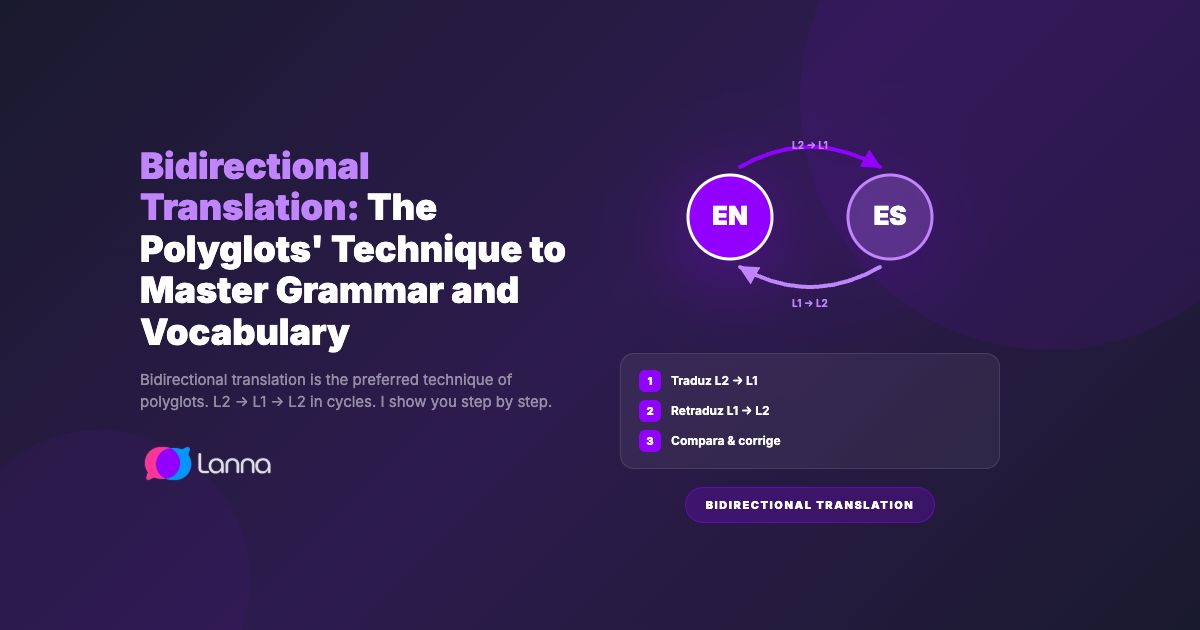
5. Bidirectional Translation
Bidirectional translation is an advanced technique: you translate a text from the language you are learning to your own, and then do the reverse. This expands vocabulary in specific themes and reveals exactly which words you are missing.
Common Mistakes When Trying to Increase Vocabulary
- Memorizing lists of isolated words: without context, the brain does not retain. Always learn within sentences and themes.
- Setting a goal of X words per day: if you don’t achieve it, you will feel frustrated. Instead, commit to having contact with the language every day — the words will come naturally.
- Writing down and never reviewing: a notebook full of words is useless if you don’t go back to them. Use spaced repetition.
- Focusing only on "difficult" words: the 1000 most common words cover ~85% of everyday conversations. Start with them.
Summary: How to Increase Vocabulary in Another Language
- Learn through context: words grouped by theme stick better than random lists
- Use multiple techniques: reading, videos, music, flashcards, translation — each reinforces in a different way
- Repeat a lot: it takes 15-20 exposures to learn a word. Repetition is key
- Don’t be too hard on yourself: have daily contact with the language, and the vocabulary will grow naturally
- Choose content that interests you: motivation is what keeps you in contact with the language long enough
Want to start expanding your vocabulary now? On Lanna, you can save words while studying any material, and the app generates flashcards with automatic spaced repetition — each word has native audio, translation, and examples in context. It’s the most efficient way to build your wall of bricks.