
Why Talking to Yourself is the Favorite Technique of Polyglots?
If you could choose just one technique to unlock your speaking in another language, it should be this: talking to yourself. It may seem strange, but it’s the most used technique by polyglots around the world — and there are very concrete reasons for this.
When you talk to yourself in the language you are learning, two things happen simultaneously. First, you identify your strengths — the moments when your speech flows naturally, without hesitation. Second, and more importantly, you discover exactly where you are getting stuck: lack of vocabulary, difficulty with conjugation, insecurity in pronunciation.
This clarity is rare in other forms of practice. In a conversation with another person, social pressure and anxiety mask your weaknesses. Alone, without an audience and without judgment, you see reality with total honesty.
How to Practice Speaking to Yourself Every Day?
The technique is simple: ask yourself questions and answer out loud, in the language you are learning. It doesn’t have to be complicated. Start with everyday questions:
- "What did I have for breakfast?" — describe what you ate, how you prepared it, if you liked it
- "How was my day?" — recount the day’s events as if you were talking to someone
- "What am I going to have for dinner today?" — plan the meal out loud, describing the ingredients
- "Why did I start learning this language?" — explain your motivations, your goals
- "What did I do over the weekend?" — narrate the activities as if you were responding to a colleague
These questions serve as “icebreakers” with yourself. Just like in a real conversation, the hard part is starting — once you answer the first question, the flow comes naturally.
When and Where to Practice?
One of the biggest advantages of talking to yourself is that you can do it anywhere, at any time. The best moments are the so-called “dead times” — periods of the day when your mind is idle:
- In traffic: in the car, describe what you see or plan the day out loud
- In the shower: it’s the perfect moment — no one will hear you and your mind is relaxed
- Walking: while strolling or going to the grocery store, narrate mentally (or quietly) what you are doing
- Cooking: describe the recipe, the steps, the ingredients — everything in the language
- Before bed: summarize your day, as if you were writing a spoken diary
The secret is to transform moments that already exist in your routine into practice opportunities. You don’t need to set aside a special time — just redirect the internal monologue that already happens naturally.
What to Do When You Get Stuck in the Middle of a Sentence?
Getting stuck is exactly the goal. When you are speaking and stop because you don’t know a word, can’t remember a conjugation, or can’t form the sentence — congratulations, you’ve just identified a specific weakness to work on.
Write down these gaps. If you don’t know a word, look it up later and add it to your vocabulary. If you made a mistake with a conjugation, notice how it appears in the content you consume. Each “stuck” moment is a precise diagnosis of what to study next.
This cycle of talk → identify gap → study → talk again is extremely efficient because it makes studying targeted. Instead of studying random grammar or generic vocabulary lists, you focus exactly on what you need.
Does Talking to Yourself Replace Talking to Others?
No — and that’s not the intention. Talking to yourself is preparation for real conversation, not a replacement. Think of it like an athlete: solo training prepares for competition, but doesn’t replace it.
The benefits are complementary. By talking to yourself, you gain mechanical fluency — the ability to form sentences without hesitation. When talking with others, you develop social language skills: interpreting unexpected responses, improvising, handling different accents.
The ideal combination is: practice alone every day to keep the “gears” running, and seek real conversations whenever possible. If you still have fear of talking to others, talking to yourself is the first step to build the necessary confidence.
Advanced Techniques for Talking to Yourself
Once the basic questions become easy, increase the challenge:
- Narrate in real-time: describe what’s happening around you like a sports commentator. "Now I’m entering the office, I’m going to turn on the computer..."
- Debate with yourself: choose a controversial topic and argue both sides. This forces advanced vocabulary and complex structures.
- Simulate situations: imagine you are ordering food at a restaurant, checking into a hotel, or presenting a project at work. Practice the phrases you would use.
- Record and listen: using your phone to record your monologues allows you to identify pronunciation errors that go unnoticed in real time.
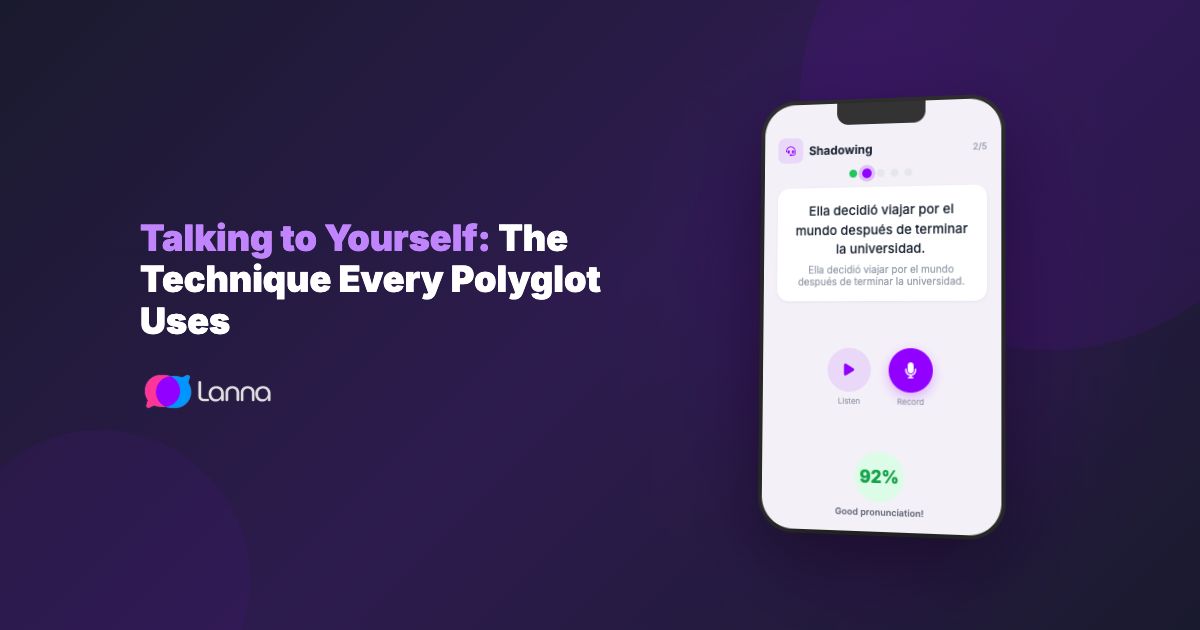
The shadowing technique also pairs perfectly with talking to yourself: you imitate phrases from natives and then try to reproduce similar structures on your own.
Summary: How to Start Talking to Yourself Today
- Choose a moment of the day — traffic, shower, walk
- Ask yourself a simple question in the language and answer out loud
- When you get stuck, write down the word or structure you missed
- Study those gaps and try to use the new words in the next session
- Gradually increase the complexity — from simple questions to narrations and debates
Talking to yourself is free, doesn’t require scheduling, doesn’t depend on anyone, and can be done anywhere. It’s the technique with the best cost-benefit ratio that exists for unlocking speech.
Want to go further and practice speaking with feedback? At Lanna, you can train pronunciation with artificial intelligence — the app compares your recording to native audio and gives a score from 0 to 100. You can also chat with the AI in speaking and chat mode, practicing speech interactively. Start for free and discover your strengths and weaknesses.